Replicación y dinámica nuclear
Biología del Genoma
Descripción
Research Project
Our research focus is to decipher how cell identity and gene expression are regulated during cell division and understand the implication of these molecular processes in various human diseases. We focus on a particular moment of the cell cycle: the S phase, that is when the genetic material is duplicated. During DNA replication, chromatin undergoes significant structural alterations. The progression of the replication machinery forces the unwinding of the two DNA strands, creating topological constrains and promoting the eviction of nucleosomes and chromatin binding proteins ahead of the replication fork. This leads to changes in chromatin accessibility and a dilution of the epigenetic information that can alter gene expression regulation.
Given that chromatin restoration can span hours, in our group we want to analyze the impact of all these chromatin rearrangements in key biological processes focusing on the following lines of research:
1. Explore how chromatin replication alters RNA polymerase II (RNAPII) activity
2. Investigate how chromatin replication modifies RNA synthesis
3. Unveil how these molecular mechanisms impact on human diseases linked to cell division such as cancer
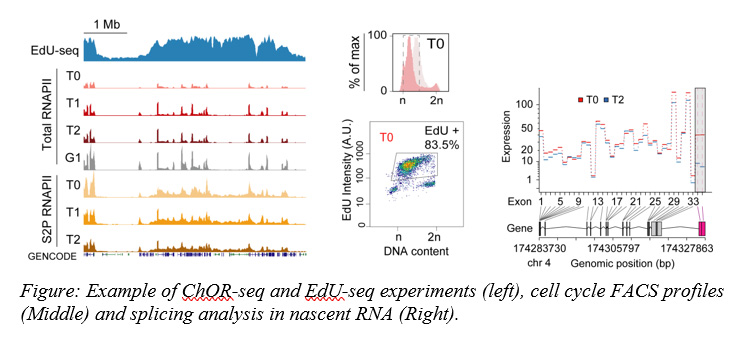
To achieve our research goals, we use human and mouse cell cultures and employ cutting-edge molecular biology techniques coupled with high-throughput sequencing (such as ChOR-seq, ChIP-seq, RNA-seq, ChrRNA-seq, EdU-seq) to explore newly replicated chromatin and newly transcribed RNAs.
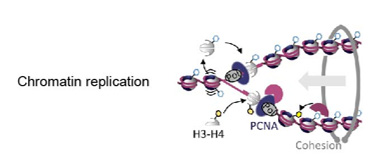
Our findings have revealed that after chromatin replication both chromatin rearrangements and transcription-replication conflicts produced during normal DNA replication alter RNAPII activity and lead to transient quantitative and qualitative changes in RNA synthesis. Understanding how all these events are regulated will be critical to understand physiological and pathological human processes linked to cell division and will help us to design new and more effective treatments to human diseases such as cancer.
If you are interested in joining our group as a master student, PhD student or Postdoc, please send us your CV to: cristina.gonzalez@cabimer.es
Funding:

Miembros actuales


Contacto
Email: contacto@cabimer.es
Web: https://cabimer.sombradoble.es
