Reparación de cortes de doble cadena en el DNA
Biología del Genoma
Descripción
Research areas:
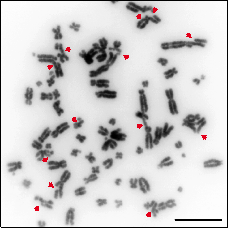 Chromosome breaks, commonly known as DNA Double Strand Breaks (DSBs) are the most cytotoxic genetic lesion known to man. Most usually, unrepaired DSB leads to cell death and for that reason their repair is essential for normal development. While the complete inability to repair chromosome breaks leads to embryonic lethality and cell death, mutations that hamper this repair lead to an increase on genomic instability, a driving force in cancer development and the cause of several rare diseases. Thus, defects in DSB repair cause genetically inherited syndromes, with or without cancer predisposition. The phenotypes associated with these syndromes are extremely varied, and can include growth and mental retardation, ataxia, skeletal abnormalities, immunodeficiency, premature aging, etc.
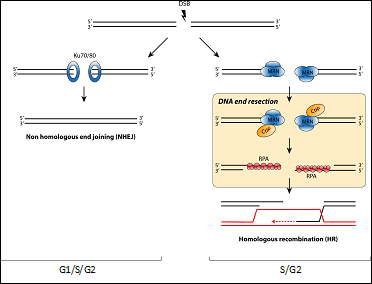 Chromosome breaks are repaired by two major mechanisms that compete for the same substrate. Both ends of the DSB can be simple re-joined with little or no processing, a mechanism known as non-homologous end-joining (NHEJ). On the other hand, DSBs can be processed and engaged in a more complex repair pathway called Homologous Recombination (HR). This pathway uses the information present in a homologue sequence. The balance between these two pathways is exquisitely controlled and its alteration leads to the appearance of chromosomal abnormalities and contribute to the diseases aforementioned. However, and despite its importance, the network controlling the choice between both is poorly understood. A critical step in the decision between both repair pathways is DNA end resection, a 5’-3’ degradation of one strand to create single stranded DNA. It is considered the key element in the decision between HR and NHEJ, as resected DNA is the substrate of recombination machinery and, more importantly, resected DNA effectively block NHEJ.
In our laboratory we are currently pursuing several research lines designed to investigate how the choice between both DSBs repair pathways is made, its relevance for cellular and organismal survival and disease, and its potential as a therapeutic target for the treatment of cancer and some genetically inherited disorders. This research lines can be divided in two main categories:
1. Detailed characterization of the role of CtIP in homologous recombination.
A key factor on the DSB repair choice is CtIP, a multifunctional protein that integrate multiple cellular signals. Moreover, we discovered that some CtIP mutations cause a Seckel-like syndrome, a genetically inherited dwarfism, Jawad syndrome and that CtIP is lost in aggressive breast cancer. In terms of DSB repair, CtIP act as a molecular switch that activates homologous recombination by activating the DNA resection step. Despite the importance of CtIP in this licensing step, we still not know how it acts molecularly. Thus, some of our efforts are set in characterize the molecular roles of CtIP and its regulation.
2. Global regulation of the balance between NHEJ and HR : relevance in cancer development and treatment.
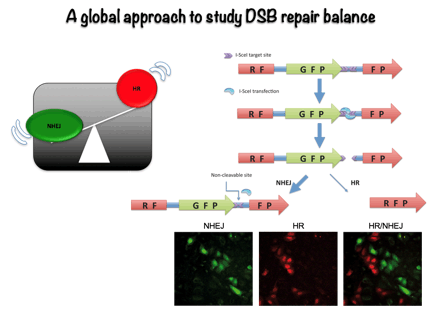
Most studies have traditionally focus in a specific mechanism of DNA repair, either NHEJ or HR. However, more recently it has become evident than miss regulation in the choice between different repair pathways might have stronger consequences for higher eukaryotes than simply blocking DSB repair. Thus, we have decided to study how the cell exerts the regulation between both repair types. To do so, we employed genomic approaches to try to find out the relevant components in this regulatory network using an easy, fluorescence based, assay to measure the ratio between NHEJ and HR. This way, we have discovered more than 300 new factors that control the choice between the different DSBs repair pathways. Currently, we are analyzing the role of those new factors in DSB repair pathway choice, mainly at the level of DNA resection licensing.
If you want to apply to our lab as a Master Student, PhD Students or Postdoc a send motivation letter, CV and contact details to pablo.huertas@cabimer.es. Postdoc applicant should include also the contact details of at least two referees.
Miembros actuales


Publicaciones destacadas
- Circadian regulation of homologous recombination by cryptochrome1-mediated dampening of DNA end resection
Autores: Romero-Franco, Amador; Checa-Rodríguez, Cintia; Jimeno, Sonia; Castellano-Pozo, Maikel; Aguilera, Paula; Miras, Hector; Wals, Amadeo; Jimeno-González, Silvia; Lopez-Contreras, Andres Joaquin; Huertas, PabloNature Communications (2025) - DNA topoisomerase IIß inhibition blocks DNA end resection and synergizes with PARPi in BRCA1-deficient models
Autores: Camarillo, Rosa; Prados-Carvajal, Rosario; Cruz-García, Andrés; Rodríguez-Real, Guillermo; Herencia-Ropero, Andrea; Serra, Violeta; Jimeno, Sonia; Huertas, PabloDNA Repair (2025) - EXO1 and DNA2-mediated ssDNA gap expansion is essential for ATR activation and to maintain viability in BRCA1-deficient cells
Autores: García-Rodríguez, Néstor; Domínguez-García, Iria; Domínguez-Pérez, María del Carmen; Huertas, PabloNucleic Acids Research (2024) - CtIP-mediated alternative mRNA splicing fine-tunes the DNA damage response
Autores: Prados-Carvajal, Rosario; Rodríguez-Real, Guillermo; Gutierrez-Pozo, Gabriel; Huertas, PabloRNA (2020) - Centriolar subdistal appendages promote double‐strand break repair through homologous recombination
Autores: Rodríguez‐Real, Guillermo; Domínguez‐Calvo, Andrés; Prados‐Carvajal, Rosario; Bayona‐Feliú, Aleix; Gomes‐Pereira, Sonia; Balestra, Fernando R; Huertas, PabloEMBO reports (2023) - Methylation of the central transcriptional regulator KLF4 by PRMT5 is required for DNA end resection and recombination
Autores: Checa-Rodríguez, Cintia; Cepeda-García, Cristina; Ramón, Javier; López-Saavedra, Ana; Balestra, Fernando R.; Domínguez-Sánchez, María S.; Gómez-Cabello, Daniel; Huertas, PabloDNA Repair (2020) - ALC1/eIF4A1-mediated regulation of CtIP mRNA stability controls DNA end resection
Autores: Mejías-Navarro, Fernando; Rodríguez-Real, Guillermo; Ramón, Javier; Camarillo, Rosa; Huertas, PabloPLOS Genetics (2020) - ADAR-mediated RNA editing of DNA:RNA hybrids is required for DNA double strand break repair
Autores: Jimeno, Sonia; Prados-Carvajal, Rosario; Fernández-Ávila, María Jesús; Silva, Sonia; Silvestris, Domenico Alessandro; Endara-Coll, Martín; Rodríguez-Real, Guillermo; Domingo-Prim, Judit; Mejías-Navarro, Fernando; Romero-Franco, Amador; Jimeno-González, Silvia; Barroso, Sonia; Cesarini, Valeriana; Aguilera, Andrés; Gallo, Angela; Visa, Neus; Huertas, PabloNature Communications (2021)
Proyectos asociados
Explotando la respuesta radioadaptativa para mejorar la radioterapia
Mejorando el efecto terapeutico del daño en el ADN mediado por radiación usando cronoterapia
CCAR2: En la encrucijada entre la reparación del ADN, el metabolismo celular y la señalización por estrés - CCReMeSS
Contacto
Email: contacto@cabimer.es
Web: https://cabimer.sombradoble.es
