
Ubiquitin (-like) signaling and Proteomics
Cell Dynamics and Signaling
Description
Our research group investigates the molecular mechanisms that regulate genome function and organization through ubiquitin- and SUMO-dependent post-translational modifications. These small regulatory proteins control the stability, activity, and interactions of thousands of cellular proteins, participating in essential processes such as DNA replication, DNA damage repair, gene expression regulation, and chromatin organization. The goal of the group is to understand how these signaling networks contribute to the maintenance of genome stability and how their deregulation promotes the development of human diseases, particularly cancer.
The laboratory has extensive expertise in mass spectrometry-based proteomics, developing experimental and computational approaches for the identification of protein interactions, post-translational modifications, and molecular regulatory networks on a global scale. This expertise has enabled the group to design innovative technological tools capable of studying with high precision the specificity of regulatory enzymes and their impact on cellular function. The combination of quantitative proteomics, molecular biology, genomics, and bioinformatics constitutes one of the hallmarks of the group.
IDENTIFICATION OF E3 UBIQUITIN AND SUMO LIGASE-SPECIFIC SUBSTRATES
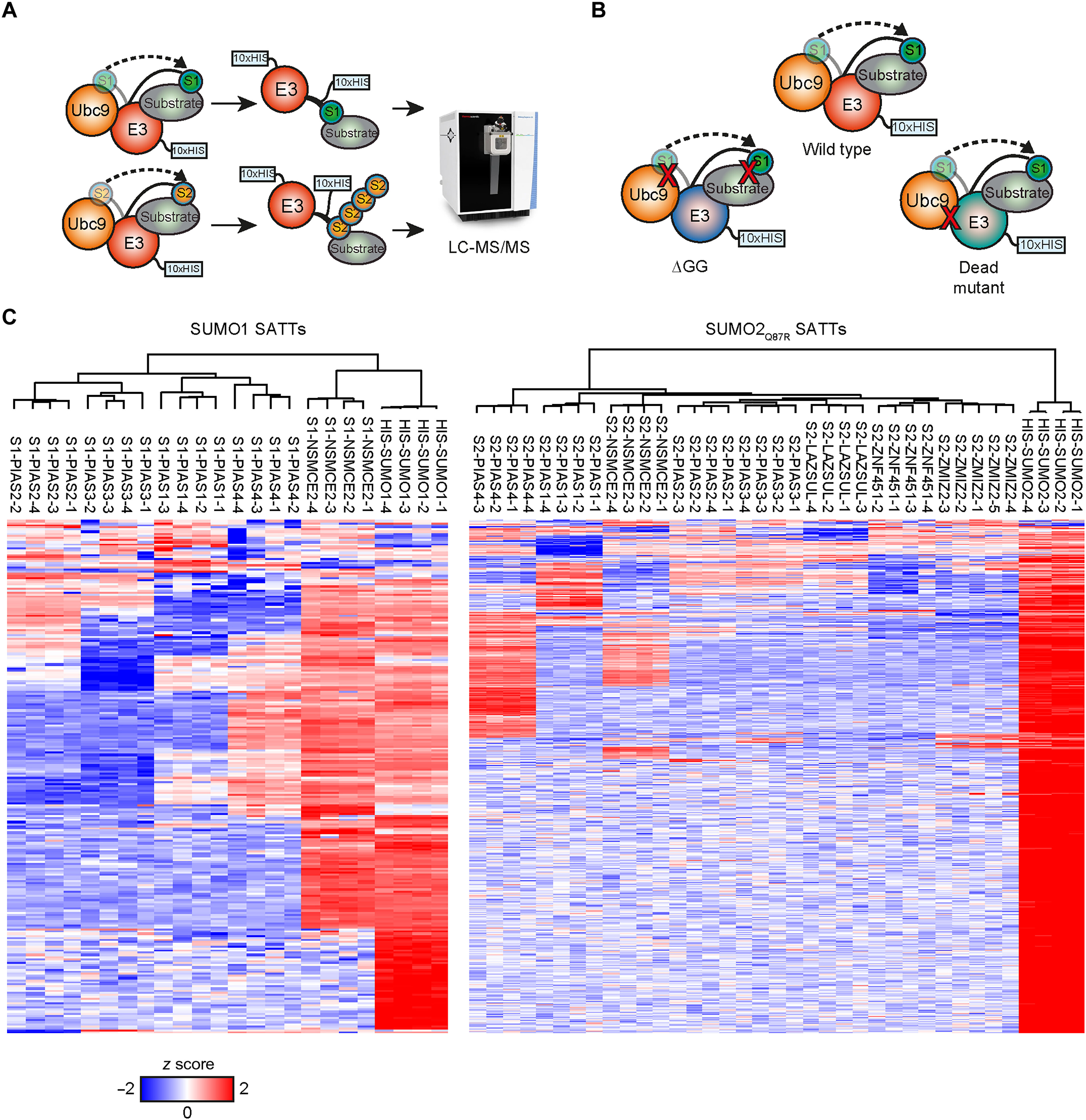
One of the laboratory’s major contributions has been the development of TULIP2 (Targets for Ubiquitin Ligases Identified by Proteomics), a pioneering strategy for the direct and specific identification of ubiquitin E3 ligase substrates. Building upon this conceptual and technological framework, the group subsequently developed SATTs (SUMO-Activated Target Traps), a methodology that enabled the generation of the first systematic map of substrates for multiple SUMO E3 ligases. These technologies have helped define the functional specificity of ubiquitination and SUMOylation systems, providing valuable resources for the international scientific community and establishing the group as a leader in the study of post-translational modifications through high-resolution proteomics. SATTs substrates can be browsed in an interactive manner here.
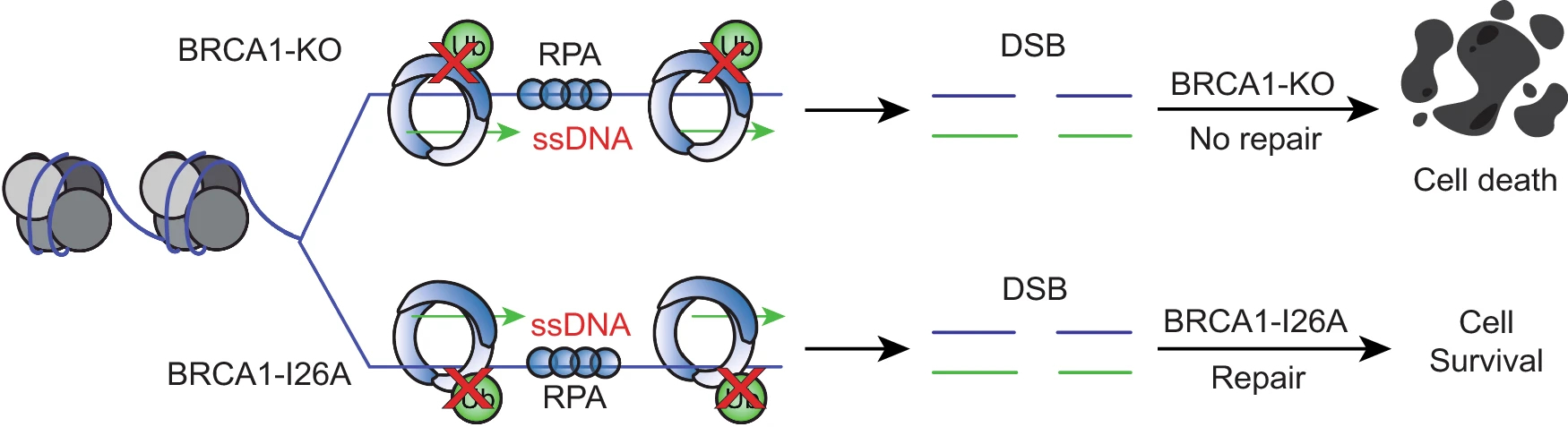
Using these approaches, the group has contributed to the discovery of novel mechanisms responsible for maintaining genome integrity. Among its findings is the identification of PCNA as a physiological substrate of the BRCA1/BARD1 complex, demonstrating that its ubiquitination during normal DNA replication is essential to prevent replication-associated defects and preserve genome stability. These results have provided new insights into the molecular mechanisms underlying cancer development and responses to anticancer therapies.
NOVEL PROTEOGENOMIC APPROACHES
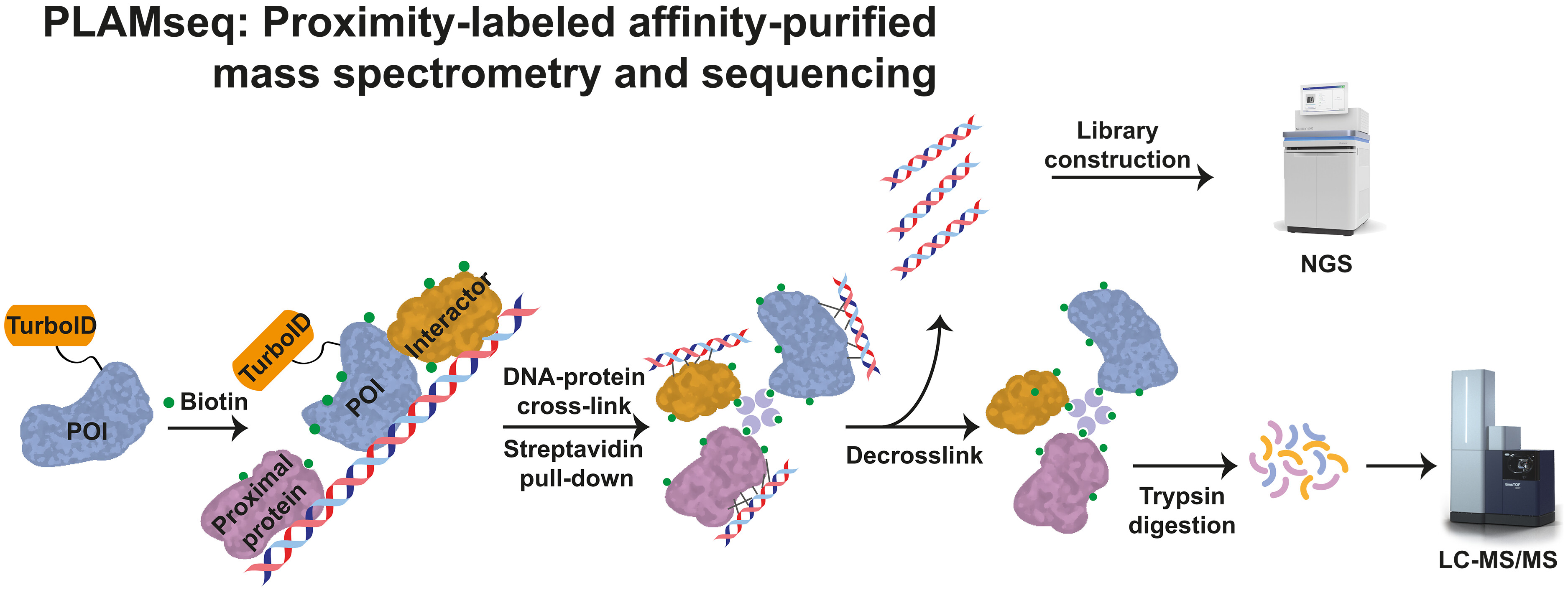
More recently, the laboratory developed PLAMseq, an innovative proteogenomic methodology that integrates proximity proteomics, mass spectrometry, and sequencing to simultaneously identify proteins associated with specific chromatin regions and the genomic locations where they act. This technology provides an integrated view of genome regulation and opens new opportunities to study epigenetic mechanisms involved in human diseases.
INTERNATIONAL POSITIONING
The group’s research is supported by a strong network of international collaborations with centers of excellence across Europe and North America in areas such as advanced proteomics, structural biology, DNA repair, epigenetics, and cancer biology. These collaborations facilitate access to cutting-edge technologies, promote the international training of young researchers, and enable the study of complex biological questions through multidisciplinary approaches. Through this combination of technological innovation, excellence in proteomics, and international collaboration, the group seeks to understand the fundamental principles governing genome organization and function, as well as their roles in human disease.
Past members
PhD Students
- Daniel Salas Lloret - https://www.linkedin.com/in/daniel-salas-lloret-phd-0a2b3710a/
Defended doctoral theses
- D. Salas Lloret (2023) - Proteomics and Functional Investigation of SUMO and Ubiquitin E3 ligases - https://hdl.handle.net/1887/3643201
Selected publications
- PLAMseq enables the proteo-genomic characterization of chromatin-associated proteins and protein interactions in a single workflow
Authors: González-Vinceiro, Lourdes; Espejo-Serrano, Carmen; Soler-Oliva, María Eugenia; Soto-Hidalgo, Emily; Mateos-Martín, María Luisa; Rico, Daniel; González-Aguilera, Cristina; González-Prieto, Román
Science Advances (2025) - UBE2D3 facilitates NHEJ by orchestrating ATM signalling through multi-level control of RNF168
Authors: Yalçin, Zeliha; Lam, Shiu Yeung; Peuscher, Marieke H.; van der Torre, Jaco; Zhu, Sha; Iyengar, Prasanna V.; Salas-Lloret, Daniel; de Krijger, Inge; Moatti, Nathalie; van der Lugt, Ruben; Falcone, Mattia; Cerutti, Aurora; Bleijerveld, Onno B.; Hoekman, Liesbeth; González-Prieto, Román; Jacobs, Jacqueline J. L.
Nature Communications (2024) - BRCA1/BARD1 ubiquitinates PCNA in unperturbed conditions to promote continuous DNA synthesis
Authors: Salas-Lloret, Daniel; García-Rodríguez, Néstor; Soto-Hidalgo, Emily; González-Vinceiro, Lourdes; Espejo-Serrano, Carmen; Giebel, Lisanne; Mateos-Martín, María Luisa; de Ru, Arnoud H.; van Veelen, Peter A.; Huertas, Pablo; Vertegaal, Alfred C. O.; González-Prieto, Román
Nature Communications (2024) - SUMO-activated target traps (SATTs) enable the identification of a comprehensive E3-specific SUMO proteome
Authors: Salas-Lloret, Daniel; Jansen, Nicolette S.; Nagamalleswari, Easa; van der Meulen, Coen; Gracheva, Ekaterina; de Ru, Arnoud H.; Otte, H. Anne Marie; van Veelen, Peter A.; Pichler, Andrea; Goedhart, Joachim; Vertegaal, Alfred C.O.; González-Prieto, Román
Science Advances (2023) - Global non-covalent SUMO interaction networks reveal SUMO-dependent stabilization of the non-homologous end joining complex
Authors: González-Prieto, Román; Eifler-Olivi, Karolin; Claessens, Laura A.; Willemstein, Edwin; Xiao, Zhenyu; Talavera Ormeno, Cami M.P.; Ovaa, Huib; Ulrich, Helle D.; Vertegaal, Alfred C.O.
Cell Reports (2021) - TULIP2: An Improved Method for the Identification of Ubiquitin E3-Specific Targets
Authors: Salas-Lloret, Daniel; Agabitini, Giulia; González-Prieto, Román
Frontiers in Chemistry (2019) - The STUbL RNF4 regulates protein group SUMOylation by targeting the SUMO conjugation machinery
Authors: Kumar, Ramesh; González-Prieto, Román; Xiao, Zhenyu; Verlaan-de Vries, Matty; Vertegaal, Alfred C. O.
Nature Communications (2017)
