Cell division control
Cell Dynamics and Signaling
Description
Every time a cell divides, it must accurately duplicate and distribute its genetic material. Defects in chromosome segregation can lead to genome instability and aneuploidy, which are linked to cancer and numerous genetic disorders. Using the budding yeast Saccharomyces cerevisiae and human cells as complementary model systems, we combine genetics, cell biology, microscopy, and biochemical approaches to address fundamental questions in genome biology and cell division. In this way, our research seeks to understand how cells coordinate chromosome segregation with cell-cycle progression and how genome integrity and proper ploidy are safeguarded during cell division. Additionally, we are interested in exploring how cells can generate polarity during their division and, particularly, how the same molecular machinery responsible for genome segregation can be used to establish cellular asymmetry.
Our research is organized around two main research areas.
1.- Mechanisms that ensure faithful genome segregation
Maintaining genome integrity and proper ploidy is essential for the survival and fitness of both unicellular and multicellular organisms. A central role in this process is played by the spindle, a highly dynamic bipolar array of microtubules that captures and segregates chromosomes during cell division. The accurate transmission of genetic information also relies on a series of checkpoints that monitor the completion of critical cellular events and delay cell division until potential defects have been resolved. These surveillance mechanisms 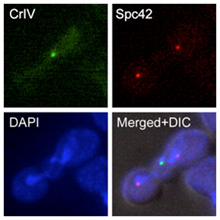 include the DNA damage checkpoint (DDC), which detects and responds to DNA lesions, and the spindle assembly checkpoint (SAC), which ensures that chromosomes are properly attached to the mitotic spindle before segregation. In addition, cells undergoing asymmetric division must also monitor spindle orientation. This particular type of surveillance mechanism was first described in S. cerevisiae, where the spindle position checkpoint (SPOC) prevents exit from mitosis when the spindle fails to align correctly with the mother–daughter axis. A major aim of our laboratory is to understand how these checkpoint pathways are activated, regulated, and integrated to guarantee faithful genome transmission.
Interestingly, although the DDC, SAC, and SPOC respond to distinct cellular cues and mainly operate at different stages of mitosis, a common feature of these checkpoints is that they inhibit mitotic exit. This observation highlights exit from mitosis as a critical target of regulatory mechanisms that preserve genome integrity. Accordingly, a central goal of our research is to elucidate the signaling pathways that govern mitotic exit and to understand how the different checkpoints regulate these signalling networks to delay the completion of mitosis when genome integrity, chromosome segregation, or spindle positioning is compromised.
Finally, another important focus of our research in this area is Aurora B kinase, a master regulator of chromosome segregation. Aurora B plays an essential role in correcting erroneous chromosome–microtubule attachments and ensuring the proper bi-orientation of sister chromatids before anaphase onset. Accordingly, loss of Aurora B activity causes severe chromosome segregation defects, aneuploidy, and cell lethality. Notably, increased Aurora B levels can also promote aneuploidy and have been associated with several types of cancer. Our work seeks to define how Aurora B activity is regulated throughout the cell cycle, how this kinase collaborates with checkpoint pathways to maintain chromosome segregation fidelity, and how perturbations in Aurora B levels contribute to genome instability and disease.
2.- Generation of asymmetry during cell division
Although cell division is often portrayed as a process that generates two identical daughter cells, many divisions are intrinsically asymmetric. In higher eukaryotes, stem cells provide one of the most important examples of asymmetric cell division. By generating one cell that retains stem cell identity and another that undergoes differentiation, these cells maintain the balance between self-renewal and tissue regeneration. A reduction in the stem cell population can lead to tissue disorganization, degeneration and aging. Conversely, an excessive 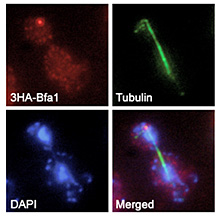 number of stem cells can promote tissue hyperplasia and contribute to cancer development. Understanding how asymmetry is generated and maintained during cell division is therefore a fundamental scientific challenge. The budding yeast S. cerevisiae provides an exceptional model system for addressing this question, since every cell division in this organism is inherently asymmetric.
An asymmetric cell division requires the establishment of a predetermined polarity axis, followed by the orientation of the mitotic spindle along this axis and perpendicular to the division plane. By aligning with the polarity axis, the spindle is optimally positioned to assist the asymmetric distribution of cellular components during cell division. A central goal of our research is to understand how cells can repurpose the molecular machinery responsible for chromosome segregation to establish polarity and generate asymmetry during cell division. In particular, we are interested in the role played by the microtubule-organizing centers (MTOCs), the structures from which the spindle microtubules nucleate and that locate at both spindle poles. In human cells, the main spindle MTOCs are known as centrosomes, whereas in budding yeast they are called spindle pole bodies (SPBs). Notably, the selective association of molecules and organelles with only one spindle MTOCs enables their differential distribution as the spindle elongates and only one MTOC enters the daughter cell.
Intriguingly, spindle MTOCs can themselves be asymmetrically inherited during mitosis. This fascinating phenomenon was first described in S. cerevisiae, and was later shown to be evolutionary conserved. Research in our laboratory demonstrated that asymmetric inheritance of the SPBs is required for yeast cells to maintain their full replicative lifespan, revealing an unexpected connection between spindle asymmetry and cellular aging. By investigating how spindle-associated mechanisms contribute to the establishment of polarity during asymmetric cell divisions, we aim to uncover fundamental principles governing these processes and gain new insights into age-related human diseases, including cancer and neurodegenerative disorders.
Funding and institutional support:

Past members
Estudiantes de doctorado (PhD students):
- 2009-2013: Mauricio Valerio Santiago (FPI)
- 2011-2017: Marta Muñoz Barrera (JAE-Doc)
- 2013-2017: Ana Isabel de los Santos Velázquez
- 2015-2019: Laura Matellán Fernández (FPI)
- 2000-2021: Inés García de Oya
- 2018-2022: Alejandra Álvarez Llamas (FPI)
- 2021-2023: María de la Paz Vázquez Aroca (FPI)
Investigadores postdoctorales (Postdoctoral researchers):
- 2010-2012: Cristina Cepeda García
- 2025: Carlos Sánchez Higueras
Técnicos (Technicians):
- 2016-2018: José Carlos Blanco Mira
- 2022: Macarena Gómez Carmona
- 2021-2023: Cristina Maya Álvarez
- 2022-2026: Pablo Magán Osuna
Estudiantes internacionales (International students):
- 2019: Eleonora Martinis (Erasmus+, Università degli Studi di Padova).
- 2020-2021: Marion Kennel (Master student, École Normale Supérieure de Lyon)
Defended doctoral theses
- 23-03-2023: “Análisis de la posible asociación específica de moléculas de ARN a los centros organizadores de microtúbulos del huso en Saccharomyces cerevisiae”. Doctoranda: Alejandra Álvarez Llamas. Calificación: Sobresaliente “cum laude”.
- 20-01-2021: “Mecanismos que regulan la salida de mitosis para el control de la correcta ploidía celular”. Doctoranda: Inés García de Oya. Calificación: Sobresaliente “cum laude”.
- 24-01-2020: "Estudio de asimetrías asociadas al huso mitótico de Saccharomyces cerevisiae: nuevos reguladores del posicionamiento del huso y la herencia no aleatoria de los centros organizadores de microtúbulos". Doctoranda: Laura Matellán. Calificación: Sobresaliente “cum laude”.
- 18-09-2017: "Búsqueda de nuevos reguladores de salida de mitosis: Hit1 y su papel en el control del ciclo celular". Doctoranda: Ana Isabel de los Santos Velázquez. Calificación: Sobresaliente “cum laude”.
- 20-01-2017: "Consecuencias de las alteraciones en la expresión de Aurora quinasa B sobre la segregación cromosómica y la progresión del ciclo celular". Doctoranda: Marta Muñoz Barrera. Calificación: Sobresaliente “cum laude”.
- 12-09-2014: "Mecanismos de regulación de la segregación cromosómica y la salida de mitosis". Doctorando: Mauricio Valerio Santiago. Calificación: Sobresaliente “cum laude”.
Selected publications
- Aurora B and INCENP co-overexpression severely disrupts mitosis and distinctly modifies the global transcriptional landscape
Authors: Galindo-Moreno, María; Muñoz-Barrera, Marta; Marcozzi, Chiara; Bruno, Federica; Maya-Álvarez, Cristina; Cortés-Ledesma, Felipe; Ríos, Rosa María; González-Aguilera, Cristina; Monje-Casas, Fernando
iScience (2025) - Characterization of a novel interaction of the Nup159 nucleoporin with asymmetrically localized spindle pole body proteins and its link with autophagy
Authors: de Oya, Inés García; Manzano-López, Javier; Álvarez-Llamas, Alejandra; Vázquez-Aroca, María de la Paz; Cepeda-García, Cristina; Monje-Casas, Fernando
PLOS Biology (2023) - Polo-like kinase acts as a molecular timer that safeguards the asymmetric fate of spindle microtubule-organizing centers
Authors: Matellán, Laura; Manzano-López, Javier; Monje-Casas, Fernando
eLife (2020) - Asymmetric inheritance of spindle microtubule-organizing centres preserves replicative lifespan
Authors: Manzano-López, Javier; Matellán, Laura; Álvarez-Llamas, Alejandra; Blanco-Mira, José Carlos; Monje-Casas, Fernando
Nature Cell Biology (2019) - Late rDNA Condensation Ensures Timely Cdc14 Release and Coordination of Mitotic Exit Signaling with Nucleolar Segregation
Authors: de los Santos-Velázquez, Ana Isabel; de Oya, Inés G.; Manzano-López, Javier; Monje-Casas, Fernando
Current Biology (2017)
