
Dra. Vivian Capilla-González
Project summary
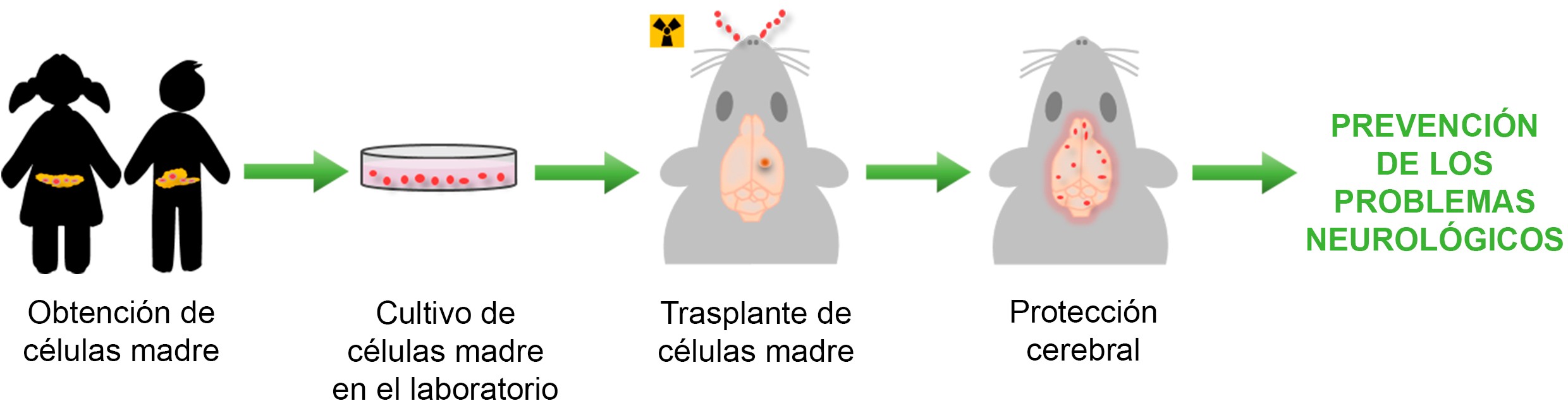
Childhood cancer survival rates are increasing significantly thanks to early detection and the development of more effective treatments. However, these treatments can leave children with severe side effects, making it difficult for them to lead a normal life after overcoming the disease. In the case of brain cancer, it is common for children to develop neurological problems, such as learning and memory difficulties, attention deficit, language disorders, or motor coordination disorders. Our research group focuses on preventing the side effects of cancer treatments in order to improve the quality of life of these “little warriors”. Through the +VIDA Project, we are developing a therapy based on the use of stem cells as a neuroprotective strategy against radiotherapy, using experimental models of childhood cancer.
How long has the project been underway?
More than 13 years ago, Dr Vivian Capilla-González began studying the effects of radiotherapy on healthy brain tissue. Her research in this area began during her stay at Johns Hopkins Hospital in Baltimore, USA (2011-2014), where she discovered that patients with brain tumours not only fight cancer, but also face serious neurological sequelae left by cancer treatments. After returning to Spain, she decided to focus on finding strategies to help minimise this damage, especially in children, whose developing brains are more vulnerable. Thus, in 2015, the +VIDA project was born, an initiative aimed at developing advanced therapies to improve the quality of life of children with cancer.
Results obtained and expected
In an initial experimental phase (2015–2019), we developed a cell therapy to prevent radiation damage in animal models. The results showed that stem cell transplantation (cell therapy) prevents neurological complications after radiation, improving cognition and motor coordination in mice. Furthermore, we observed that these effects were due to the ability of the transplanted cells to reduce radiation-induced inflammation in the brain. Shortly afterwards, we were able to verify that intranasal administration of stem cells was safe in young mice, with no short- or long-term adverse effects. All these findings have been published in international scientific journals (Cancers 2021, Front Cell Neurosci 2019). More recently, we have demonstrated that stem cells can be optimised to act as agents with antitumour potential, opening up new avenues of research in oncology (Theranostics 2025). Currently, our research is focused on understanding how the cell-based medicine works in order to enhance its neuroprotective effect and evaluate its impact on tumour progression. This step is key to developing more effective and safer strategies. Although we are still in the preclinical phase, we are confident that the advances made in the +VIDA project can be transferred to the clinic to improve health and quality of life.
Impact of the project
Although the primary goal for people with cancer is a cure, it is essential to ensure that survivors can live life to the fullest. Our project investigates an innovative strategy that, in the future, could help reduce the side effects of radiotherapy in cancer patients, ensuring dignified survival without barriers. While this therapy could be applied to adults, our main focus is on children, the population most vulnerable to these aggressive treatments. Through our preclinical studies, we are working to better understand its effects and move towards possible solutions that facilitate the integration of survivors into society. In addition, this project will help raise awareness of the challenges faced by cancer patients, promoting a change in the way society perceives and supports those who have overcome the disease. Its impact will not only be scientific and health-related, but also social.
Who is behind this project?
This project is being carried out by the Stem Cells and Translational Neurology group led by Dr Vivian Capilla-González, part of the Department of Integrative Physiopathology and Therapies at CABIMER. The group’s mission is to advance knowledge in Advanced Therapies and their application in neurological disease models. Dr Vivian Capilla-González’s experience includes 37 scientific articles, 6 patents, 28 competitive projects and contracts led, and numerous participations in national and international conferences. Currently, her research group is composed of a multidisciplinary team of experts whose commitment to the advancement of science and the improvement of patients’ quality of life is the driving force behind this project. In addition, the group has an extensive network of biomedical and clinical collaborators from national and international centres, such as the Virgen del Rocío Hospital in Seville, the Mayo Clinic in Florida, the La Fe Hospital in Valencia, the University of Granada, the University of Valencia and the various institutions that make up CABIMER, which undoubtedly favours the development of their research.
Links
Video del Proyecto +VIDA: https://www.youtube.com/watch?v=SJxyzpYBQ5E&t=5s
Video del Programa Solidarios: https://www.youtube.com/watch?v=N43De4tWIzI
Publications: https://pubmed.ncbi.nlm.nih.gov/?term=capilla+gonzalez+v&sort=date
Cuenta de Twitter (X) del grupo: @VivianCG_Lab
Cuenta de Twitter (X) del Proyecto +VIDA: @VIDAprecipita
